Why I built RevenueRegister to track cash in our businesses

Most service businesses are stuck tracking cash in spreadsheets. Here’s why I decided to fix that — and what I learned at the checkout line that sparked the idea.

Many years ago, when Forever Dental was a single office, cash tracking was simple: a drawer, a spreadsheet, and a daily audit. The owner was in the office most days. Easy.

Then they grew. More locations, more staff turnover, more hands in the cash box and spreadsheet. Formulas broke. Data got entered wrong. Reconciling revenue became a weekly headache instead of a five-minute task. The system that worked for one office was quietly falling apart with three offices.

I’d been thinking about this problem for a while when a mundane moment turned into a lightbulb.

The grocery store moment that started everything

Last year, I was at the grocery store and got to the checkout just as a shift change was starting. I had to wait while the cashier counted out the drawer — bill by bill, coin by coin — then handed it off. The new cashier arrived with a fresh, pre-counted drawer and counted it out again before taking over.

It was a small thing, but it stuck with me. This is what real treasury controls look like at the front line. Blind counting. Shift-level accountability. An auditable handoff. Banks do this. Retailers do this. Why don’t most service businesses?

The answer, I realized, is that the tools haven’t been built for them. Most point-of-sale systems are designed for retail — inventory, SKUs, product catalogs. That’s overkill for a dental office that just needs to open a drawer, record a few payments, and close out at the end of the day.

So I built something simpler.

What I built: RevenueRegister

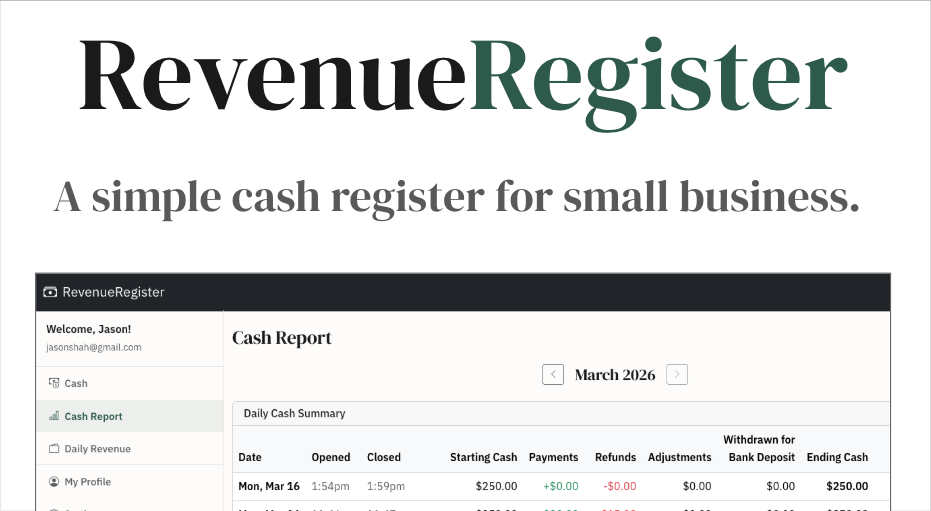
RevenueRegister.com is a cash management tool for service businesses — dental offices, auto shops, salons, and anyone else who handles cash, cards, and checks without needing a full POS system.

The core idea is borrowed directly from what I watched at that grocery store: you open a drawer session, record payments by type (cash, card, or check) throughout the day, and reconcile when you close. No spreadsheets. No broken formulas. No guessing.

Daily revenue tracking lets you log and audit revenue by category — so when someone asks “what did we bring in last Tuesday, and how much of it was cash?”, you have a real answer in seconds.

Built for teams managing multiple locations

One early focus point: this had to work for teams, not just solo operators. You can invite staff, assign roles, and manage multiple locations from a single account. Admins can switch between locations freely; staff are scoped to theirs. Everything is tracked per-location so reports stay clean and auditable.

Who it’s for

If you run a service business and you’re still tracking daily revenue in a spreadsheet, or you’ve grown to multiple locations and the spreadsheet is starting to crack — Revenue Register was built for you. It’s not trying to be a full accounting system or a retail POS. It’s the focused tool that sits between “I have cash in a drawer” and “I know exactly what came in today and who handled it.”

There’s a 14-day free trial, and onboarding takes just a few minutes. Try RevenueRegister for free today.
Large content sites and SEO

I’ve always been fascinated with large content sites, domain authority, and long-tail SEO. The idea that one can create a lot of content targeting a specific niche, get that content indexed, and reap benefits of that investment over years through monetizing long-tail SEO, always seemed like magic.

The biggest barrier to entry was always that first part: creating high-quality content that targets a specific niche.

Today, after many years of percolating on this idea, I launched an experiment: a glossary of dental terms, hosted at dictionary.dental. The term list and definitions were built over time as a part owning the web presence for Forever Dental, with some assistance of large language models to flesh out some missing areas. The design and user interface are intentionally minimalistic, as I want this to be free and clear of ads and clutter. Hosting is intentionally incredibly simple. Not quite static-site, but heavily cached and running on a simple service. The glossary concept is incredibly repeatable too, so if this experiment works, it is scalable across niches.

And just like everything, it started very simply!

Relatedly, I found a fan page for Forever Dental. Turns out, people do love their dentist!

Navigating the Product Roadmap

Navigating the Product Roadmap

As is the case at many other startup/early growth phase companies, we at Mediafly haven’t hired a product manager. “Product management may be the one job that the organization would get along fine without”, and we’ve lived by that model for the past few years. Because of this, we operate lean and create our own best practices for the meaty parts of product management, most notably the product roadmap.

The product roadmap is necessary for any enterprise-focused SaaS company that is selling multi-year subscriptions to Global 2000 companies like we are. It’s used as a communication tool for:

  • Clients, both the ones signing the checks as well as the heaviest users/admins of your product. They want to understand (and influence) what is coming down the pipeline for your product
  • Product development team members, including designers, developers, QA, and infrastructure. They want to understand what they should be thinking about from a UI/UX/architecture perspective
  • Sales and marketing. They want to know what they can sell, how it should be marketed, and provide input from a client, competitive and market-driven standpoint

Defining the Roadmap

An Example of Mediafly’s Product Roadmap

It can be easy to let the roadmap balloon into a complex, time-sucking monster. The roadmap itself is housed in Google Sheets, and broken up by product category (for us, those are SalesKit, ProReview, Airship CMS, Interactives, Reporting, andInfrastructure/Security). We organize specific entries in the roadmap into five columns, with the following definitions:

  • Discovery: Ideas/features that are “baking.” We usually hear of these ideas from clients, prospects, users, or the market, and are looking to gather more information for these ideas before we move them to the next phase.
  • Evaluation: Once an idea has gathered sufficient input, it moves into the Evaluation phase. During this phase, we’re putting together benefits statements, wireframes, high-order engineering estimates, and public-facing selling documentation.
  • Plan: After we’ve committed to building an idea as a feature, we attach a delivery date (usually a quarter, sometimes a month), and move it to Plan. Here, we are working on detailed requirements, wireframes, and phasing. We are also conducting usability tests and starting to talk about the upcoming feature with our clients and prospects.
  • Build: Once the feature reaches our design and engineering teams, it is in Build.*
  • Release: Recently released features are moved here. At this point, we’re training our clients, updating documentation, and analyzing usage in preparation for improving our newly released feature.*

It’s All in the Details

Sample Mediafly Details Document

Some entries in the product roadmap will be hyperlinked to a Details Document, which is hosted in Google Docs alongside the roadmap itself. These documents will vary in structure, but often contain:

  1. Estimates
  2. Requirements
  3. Current and proposed approaches
  4. Discussion of tradeoffs and limitations
  5. Specific customer requests

Every 3-4 weeks, I will review the roadmap with our business leaders (currently, our CEO and EVP of Sales and Marketing). We focus on what’s changed since our last meeting and discuss new data that we’re seeing from clients, prospects, and the market. Then every 2 weeks, I will review the roadmap with the Product, Engineering and Customer Success teams. We focus on what’s coming up in the near future, and often will dive into the specific points to discuss better ways to solve specific problems.

Ad-hoc, I will be asked to present the roadmap to our customers. This is usually accompanied by a short presentation that explains what the roadmap is and how it works. Over the course of any week, I’ll spend about 1-2 hours reviewing and adjusting entries within the roadmap based on conversations, research, and incoming data.

We’ve managed to keep the product roadmap useful and relevant without too much overhead over the past few years by following this model. As we grow the entire Mediafly team through 2016 and beyond, this process will certainly evolve. I’m looking forward to that evolution, and will keep you up to date as it progresses.

If you’re involved in product management at your organization, please comment below with your best practices. I’d love to hear from you!

(Cross-posted on the Mfly Blog)

Why does Amazon.com allow crazy prices?

I was looking for a bike helmet for our 2-year old son, and pulled up “kids’ bike helmets” on Amazon.

Amazon Kids Bike Helmets

Look at that first entry closely. Specifically, look at the upper bound on the price range.

Ridiculous upper bound on kids bike helmet on Amazon.com

Why would Amazon allow an upper bound price like that on such a simple item? Is it purely oversight, or is there some crazy psychological result that results in more sales when items are merchandised this way? Does anyone know?

Strategy is Culture

Mediafly in the Inc 5000

(Cross-posted from the Mediafly Blog)

When I used to envision how small companies create a great strategy, I would often imagine a single or multiple leaders sitting down and writing out something to the effect of “here are the three things that we’ll do to win.” The picture in my mind is complete with a boardroom or conference room, men and women wearing business suits, and hours of PowerPoint presentations at the ready. My experiences at a management consulting firm reinforced this: oftentimes, decisions started as hypotheses by the most senior leaders, and were then justified back to them by consultants who gathered and made sense of data.

After growing Mediafly by 657% over the past three years (and that’s not even including 2014 or 2015 numbers), I’ve come to shift my mental picture of how strategy is built at small companies. The big conference room is replaced by a small one, often with people on the other end of GoToMeeting; suits are replaced by jeans; PowerPoint is replaced by conversation with a few bits of data thrown in; and the confidence of “here are the three things that we’ll do to win” is replace by “here are what we think might be good to try, based on a little bit of data, a lot of intuition, and a willingness to adjust as we learn.”

But the biggest surprise in my mental picture comes from how we develop strategy. Our strategy is highly influenced and often derived by our incredibly empowering culture and system of ad-hoc conversations.

What makes our culture empowering?

At Mediafly, engineering, customer success, marketing, sales, and even interns have open, candid conversations with the executive team every day, passing along ideas and feedback in both directions. Customers can pick up the phone or write an email to anyone on the team, and expect to get help to solve issues. If team members find something they don’t like about any system, they are empowered to proactively fix it. Many team members work across divisional lines (engineering and marketing; sales and product; marketing and customer success), which empowers those team members to fix and grow even more.

What are ad-hoc conversations at Mediafly?

As a result of the culture, our team members find themselves in ad-hoc conversations about all parts of the business every day. Conversations will form at each others’ desks, over lunch or drinks, on our messaging systems (GChat, HipChat), and of course by email. These all serve to align how each of us thinks about our company’s place in the world. All of this coalesces and informs our company’s strategy.

A couple of great examples of what I mean:

Example 1:

Our strategy focuses on “content mobility”. Previously, this meant mobile (and primarily iOS) apps. However, several inputs came together to help us broaden and redefine this this past year:

  • Sales: We had several sales meetings in which it became clear that many companies simply won’t ever buy iPads for their sales staff
  • Product: After analyzing our usage data, we realized that the primary platform for using Mediafly is through our Web Viewer on a desktop browser (not a mobile device and not one of our apps)
  • Customer Success: A few conversations with existing customers crystalized that a desktop app would go a really long way to embracing Mediafly
  • Market: Windows Surface and touchscreen Windows 8 hybrid tablets are starting to gain traction

These inputs came in through our empowered team members thinking about their areas, via conversations at each others’ desks and at meals.

Assimilating these inputs was easy, when there were so many of them pointing in the same direction. As a result, we’ve begun to work on a desktop application and plan to release it within the next several months (stay tuned!).

Example 2:

We originally developed our Interactives Platform back in Q2 2012. At the time, we assumed Mediafly would build a consulting arm that caters to creating Interactives via consulting services to our enterprise customers, while our core team focuses on enterprise software licensing. We operated under this approach for almost a year, netting a reasonable amount of consulting work.

However, again, several inputs from our empowered team members, gathered via many conversations, helped reshape how we think about this:

  • Engineering and Product: Every time Engineering was pulled into an Interactive engagement during this time period, we had to delay work on the product side for a custom piece of work. However, the product side is where the bulk of our “enterprise value” would eventually come from.
  • Team: Getting sucked into consulting engagements of this form was extremely hard, and team members were working way longer than normal. This was largely because we weren’t used to the multiple back-and-forth design rounds required for consulting to overlap with product work, and time was tight.
  • Industry: we started to meet some great agencies and software development firms, and believed they could be incredible partners.

We made the decision in 2013 to terminate all new Interactives development for our customers (with a few exceptions). The result has been amazing: better products, better focus, happier customers, and partners who are doing amazing work.

As we continue to serve more customers with our phenomenal products and services, we will strive to:

  • Ensure team members continue to feel empowered to bring up ideas and issues,
  • Keep lowering friction for ad-hoc conversations to take place, and
  • Drive company strategy based on the output of our culture, as much as it is based on other external factors

The consolidation of tablets and laptops begins

IDC announced today that worldwide tablet sales growth is expected to slow to 7.2%, and that iPad shipments will decline by 12.7%, the first year-over-year decline in the history of the product’s existence. This is significantly different from their 2013 report, which showed a year-over-year growth rate of 50.6%.

This announcement coincides with what I’ve been predicting for the past two years:from an enterprise perspective, tablets and laptops will largely consolidate to a single form factor.

The drivers are clear. Enterprise users want to be able to work effectively, regardless of what device their working on. They don’t want to carry around multiple devices and companies don’t want to supply or manage multiple devices. The iPad is a revolutionary device but it’s strengths still lie in content consumption, not content creation. Another limitation is the fact that users don’t want to have to have another upgrade path on tablets that is separate from their phones and their laptops. And on top of that, companies struggle to keep up with device upgrades.

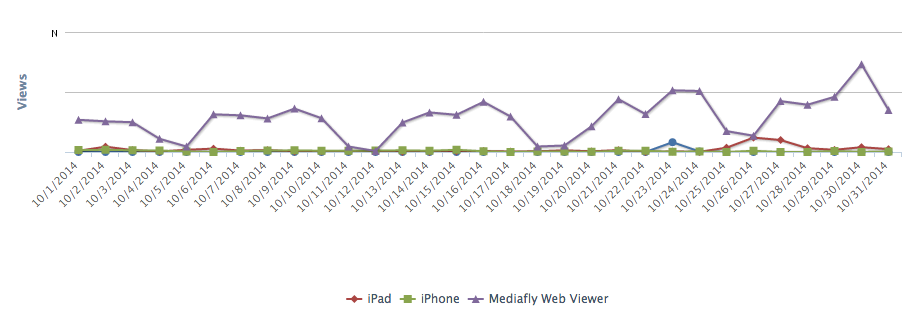
Despite prior years showing the significant growth of tablets as a device platform and Mediafly being a “mobile-first” enterprise software company, we’ve seen that our web viewer still ranks as the top platform. The device report below is from one of our enterprise customers and illustrates how important the browser is (represented by Mediafly Web Viewer).

Our web Viewer gets the most usage


We see a number of additional data points over and over that further justify this trend:

  • Many customers and prospects are hesitant about rolling out iPads to their salespeople and general employee base as they work to reconcile the capital expense and challenges of managing another track of devices with the enablement benefits they provide.
  • More and more of the new Windows PCs are tablet hybrids as well, with full touch screens, detachable keyboards, and a full-featured operating system behind it. We are eagerly awaiting OS X to support these features as well, and expect this to happen in the coming 1-2 years as tablet sales decrease even faster.
  • Larger phones (e.g. iPhone 6+, Galaxy S5, and Nexus 5) are decreasing the importance of also carrying around additional devices such as tablets and laptops.

What are we doing about it?

In anticipation of this shift, we are working on a new desktop solution that will work on multiple operating systems (Windows 7 and above, and Mac OS X 10.8 and above) and support all of our mobile app features including: full offline access, offline search, intelligent syncing, and Interactives. The desktop solution will remove the line between devices and will allow an end user to experience the benefit of our solutions everywhere.

Our target timeframe for launch is Q3 2015. We’ll keep you updated on our progress and share details along the way.

(Cross-posted on the Mfly Blog)

Praise and criticism of “The Other IPO Roadshow”

Deepak Jeevan Kumar of General Catalyst Partners wrote a pretty good overview piece on TechCrunch describing his point of view of how to launch a F500-focused enterprise software company. Many parts of it ring true based on our experiences at Mediafly and my previous experiences:

CIO offices in Fortune 500 companies are trained to play it safe. Many companies stick to Oracle, VMWare, EMC and Cisco not because their products are the best in the world, but because no one got fired for selecting one of them.

That’s so very true. Often this is driven by their own experiences, but just as often it’s driven by internal politics. We heard recently from a customer (who was discussing another part of their business, thankfully) “if we don’t go with Microsoft for [terrible product A], our prices will go up on [pretty good product B used somewhere else], and we can’t have that.”

Do not use unpaid PoCs even if you have to wait one to two months to get a paid PoC.

This is very important. Customers that don’t put money behind a proof of concept simply don’t have enough skin in the game. We’ve been on the wrong end of this story before:

  • Prospect says “well, if you have feature X, I’ll be willing to buy then.”
  • You spend days/weeks/months building feature X, in hopes of securing their business
  • You show feature X to prospect
  • Prospect says “Great! Now, if you have feature Y, I’ll be willing to buy then.”
  • Repeat

Customers who are not willing to engage in a paid proof of concept are not worth it, no matter how large.


Some parts of Deepak’s perspectives don’t seem right:

Second, power and influence in the early days can come from public silence for enterprise startups (unlike consumer startups). Your competitors, the media and your customers like a game of treasure hunt to find out what you are doing.

In reality, as a “stealth startup”, no one really cares what you are doing. And the last thing customers want to do is to spend time trying to dig to learn your secrets. They are usually too busy running their business.

As you are selling to a select group of Fortune 500 customers, there is no point in announcing to your powerful enterprise tech competitors (e.g Cisco, Oracle, IBM, HP) what you are up to. Convince your design customers first before you open up the kimono.

Again, even if your largest competitors figure out what you are up to, it’s highly unlikely that they will try to usurp your untested, unproven ideas. They are busy running their businesses and executing on their product and company vision, to bother trying to knock you out. Of course, all this changes when you start to generate real traction and, more importantly, win deals from under their nose. But you are not at this stage yet, pre-customer startup.

That being said, I do agree with the general premise that you shouldn’t spend time talking about the product too publicly. But for these reasons. I believe that’s the case because you should be 100% focused on executing on delivering your product to these large companies that are taking a chance on you. Spending time engaging in PR is a waste of your time, as you haven’t proven anything yet.


Overall, this article is definitely worth a read for anyone starting down this road.

How I spend my day

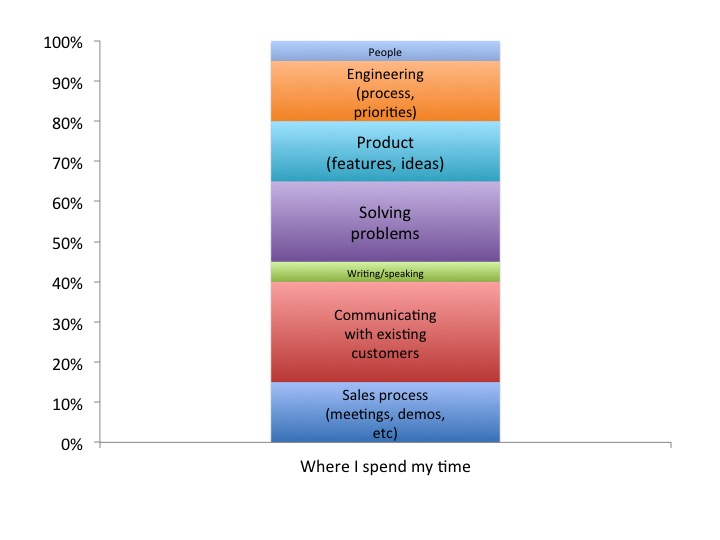
I was asked by a member of our Chicago startup community to detail what the day-to-day life of the CTO looks like at Mediafly. I thought I’d share how I spend my time, summarized in this graph:

Where I spend my time

As you can see, my role pulls me in a lot of different directions. Often, what I believe I will be doing at the start of the day turns out to be completely wrong by the end of the day looking back.

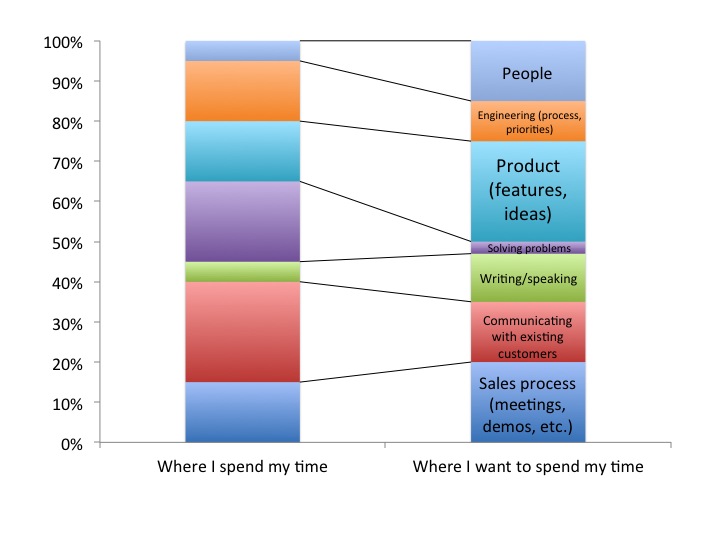
This graph doesn’t state much in isolation.  More interesting is when I pair this with where I want to spend my time (assuming Mediafly is no more than double its current size):

Where I want to spend my time

As we grow, I want to spend less time troubleshooting client issues, and more time with the product, with prospective customers, with my team, and writing and speaking.  Put another way, I want to spend more time being externally focused and be able to further rely on my team to make things happen.


The following notes apply when reading this:

  1. This is how I spend my time. It is not meant to be prescriptive, and It will almost assuredly differ from how you spend your time in the same role at the same company.
  2. I am the CTO of Mediafly, a high-growth enterprise mobility software-as-a-service company. We turn enterprise content and data into compelling mobile experiences. We have approximately 25 employees and contractors, the bulk of whom reside in engineering and services.
  3. My experiences and time allocation will differ from the CTO of a consumer-focused startup, established enterprise software company, or internal IT CTO.

I plan to update this post over time as my thoughts evolve.  As always, feedback is welcome!

Introducing Mediafly Airship

I’m proud to have worked with my colleagues at Mediafly to beta-release Airship, the web-based content management system that we’ve been working on for almost a year.  It’s been a fantastic experience conceiving of, designing, and working with them to build the system.  I’ve learned a few things about introducing new products during this process.

  • Speed is essential. The engineer in all of us on the team wants to build a robust, scalable system up front. But doing so has gotten us into trouble in the past. So, this time, we opted to build super-fast, and worry about scalability when we need to. After all, while we may have a guess as to what the scalability challenges may be 6 months from now, we could be very wrong. So it’s better to kick the can down the road at this early stage.
  • Saying no to feature requests is hard. Very very hard. Especially to ones that are good ideas, but are not a part of the Minimum Viable Product (MVP).
  • Frequent meetings and checkins are important. We met 2-3 times/week in 5-minute standup meetings, and informally lots of times/week to hash out ideas.
  • What was hard in the old system is easy now.  With our old Publisher system, getting the media into the system took ages. Users had to use a user-unfriendly “filechucker” that we wrote years ago, to incrementally upload files. Or, they would have to paste a URL. This time we used highly developed open source tools, and as a result, importing is as easy as dragging and dropping into your browser.
  • What was easy in the old system is hard (for now). Assign security groups to a large number of files was relatively easy. Now, (at least in MVP), it requires making changes to each file independently. While this is a short term solution, it is incredibly error prone and time consuming.

Lots more thoughts coming soon. In the meantime, congratulations team, and keep on flying!